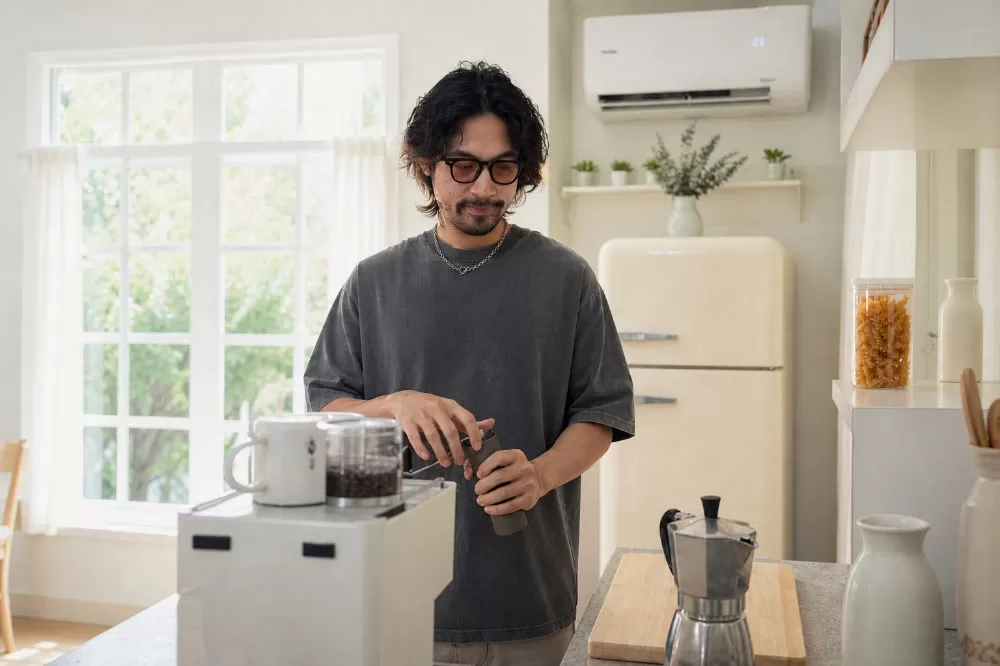
Most of what makes a coffee taste of its origin is held inside the bean as aroma. Roasting builds it, and the bean's structure keeps it in. Grinding opens that structure, and from then on the coffee is changing by the minute.
That is the whole argument for buying whole beans and grinding them yourself, just before you brew.
What grinding does to a bean
A roasted bean is a sealed, porous shell. It holds carbon dioxide made during roasting, along with the volatile compounds that carry a coffee's aroma. While the bean stays whole, both leave slowly, through a small outer surface.
Grinding breaks one bean into thousands of fragments. The surface exposed to air grows many times over, the trapped gas escapes quickly and takes aroma with it, and oxygen reaches the oils that were protected a moment before. Staling that takes weeks in a whole bean takes hours in ground coffee.
What you taste when it fades
- Less aroma — the floral and fruit notes go first, because they are among the most volatile
- Flatter acidity, so a bright coffee reads as dull rather than clean
- More bitterness and a papery, cardboard edge as the oils oxidise
- A thinner, weaker bloom in a pour over, because the gas that drives it has already gone
A coffee like Lourdes, grown at 1,500 masl in Sagada, Mountain Province, is bought for its citrus and soft floral lift. Those are exactly the notes that ground coffee loses first.

One grind does not fit every brewer
Grind size sets how quickly water extracts a coffee. Espresso needs it fine, a French press needs it coarse, and a pour over sits between the two. Grinding at home lets you match the grind to the brewer you are using that morning.
It is also the main adjustment you have. If a cup tastes sour or thin, grind finer. If it tastes bitter or dry, grind coarser. Pre-ground coffee fixes that setting on the day it was ground. Our brew guides for pour over, French press and the espresso machine give a starting grind for each.
Choosing a grinder
A burr grinder crushes beans between two burrs set a fixed distance apart, so the particles come out close to one size. A blade grinder chops at random, leaving dust and chunks together. The dust over-extracts and turns bitter, the chunks under-extract and taste sour, and no recipe can correct for both at once.
A hand grinder with steel burrs is enough for one or two cups a day. It is quiet, it lasts, and it costs less than a good electric one.
A simple routine
- Weigh the dose as whole beans, then grind only that
- Grind in the last minute before the water goes on
- Keep the rest of the beans in their sealed bag, away from light and heat
- Brew within a few weeks of the roast date printed on the bag
Static can scatter fine grounds across the counter. Our ceramic dosing set pairs a bowl for weighing beans with a spray bottle; a single light mist before grinding settles it.
If you do not have a grinder yet
We grind to order. Choose filter, espresso, French press or moka pot when you buy, and we grind for that method before your coffee is packed. Ground coffee will not keep as long as whole beans, so buy a smaller bag and use it sooner.
A subscription helps with that. Coffee arrives at the pace you drink it, ground or whole, and never sits long enough to fade.